Healthcare
How an eight-year-old boy inspired the foundation of the Haemophilia Society
Written by Sam Wilson, May 1, 2025
When Joseph O’Rourke co-founded the Haemophilia Society in 1950, very few people in the medical profession expected his eight-year-old son with severe haemophilia to survive beyond his teens.
Now 82, Terence O’Rourke can reflect on a hugely successful career, a long, happy marriage and a life which continues to be fulfilling, in part thanks to his father’s determination.
Terence’s early childhood memories are of unpleasant hospital stays and air raid shelters. There was no treatment for haemophilia and not much optimism about what people with the condition could achieve.
It was against that backdrop that his father, Joseph, met others with haemophilia, including Frank Smith, Bob White, Philip Morris and the Hubbard family. Together they formed the Haemophilia Society to improve understanding of the condition and to stimulate medical interest in developing better treatment.
An orphan raised by aunts in Ireland, Joseph was a member of the Garda before joining the RAF in 1940 and moving to England, where he met his wife Frances, a nurse. With no family history of haemophilia, their son’s diagnosis was a life-changing moment for the couple. Rising to the challenge, Joseph proved to be a determined, persuasive and highly effective advocate for the haemophilia community.
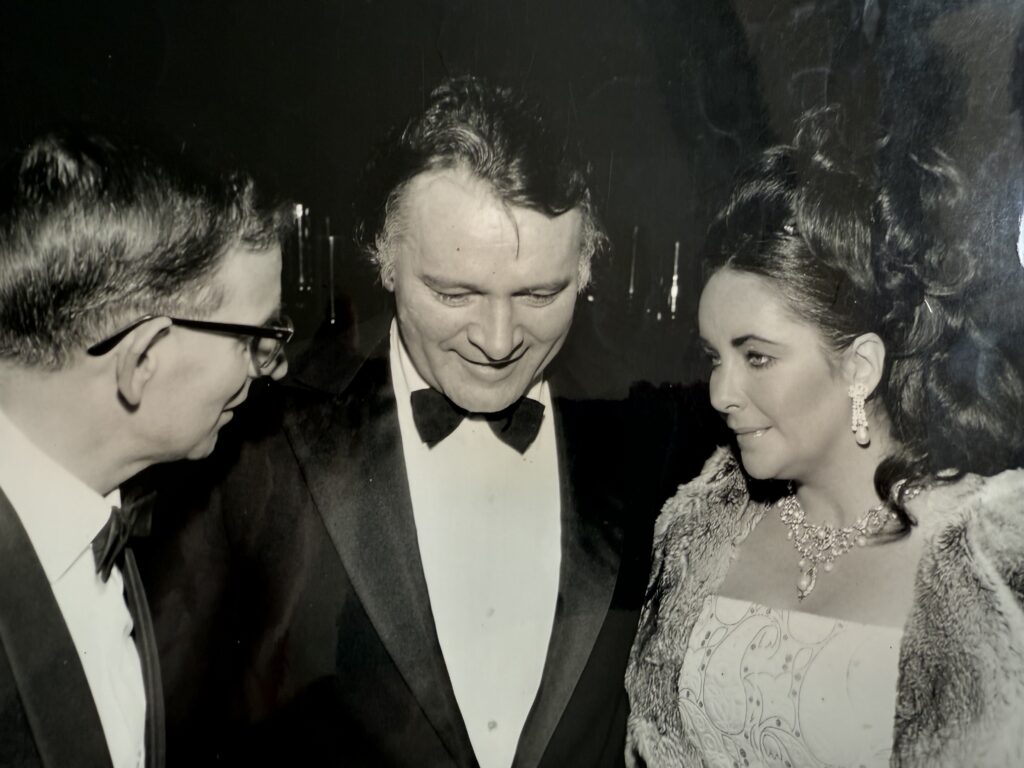
When Oxford Haemophilia Centre couldn’t accommodate its new – and first – consultant in the late 1960s, Joseph arranged for a caravan to be borrowed from a local firm to act as his office. He also persuaded the actor Richard Burton to donate the proceeds of the gala premiere of his latest film, ‘Where Eagles Dare’ to the haemophilia community in 1969. With no previous experience, he pulled off a glittering event, attended by the great and the good, including Richard Burton’s film star wife Elizabeth Taylor and Princess Alexandra.
The new society also attracted influential medical professionals to push the needs of people with haemophilia further up the priority list. Sir Lionel Whitby, Principal Medical Officer at the Department of Health was recruited as its first president, followed by his successor in the role, Sir Weldon Dalrymple-Chapneys.
Reflecting on his father’s achievements, Terence said: ‘I’ve always been very proud of my father, he was an amazing person. He worked like a Trojan to make a success of the Haemophilia Society and his positive attitude is part of who I am now.’
Terence’s education was significantly affected by his haemophilia. Unable to go to school, he had patchy home tuition from a succession of teachers. With severe haemophilia A and no treatment, joint bleeds were constant Frequently spending long spells bed bound he read anything that was available and it is much of this reading that made him dream of becoming and architect.
When Terence told a careers adviser of his plans, he laughed and said, ‘people like him didn’t do jobs like that – they were normally unemployed’.
Terence proved him wrong and went on to study architecture and then town planning, eventually running his own large practice in the south of England. He has also been influential in the arts and for 10 years was Chair of the Bournemouth Symphony Orchestra.
Terence said: ‘Having haemophilia made me a strategist, I had to work out how to solve the most complex things and put them into action. In a way I tried to avoid my haemophilia. I wanted people to value me for what I could do, not undervalue me because I’d got blood problems.
‘My parents always told me that I’d have to be twice as qualified as the people I was competing against for jobs, as they had a health advantage, and they were right. There’s always been prejudice against haemophilia, even before hepatitis and HIV infections.’
That prejudice spilled into Terence’s personal life when his future wife’s parents objected to their marriage because of his haemophilia. They made her choose between them, refusing to attend their wedding. Fifty-seven years later the couple are still very happy together today and Terence attributes his long life largely to the care of his wife Annette.
Terence developed a mistrust of the medical profession in his teens, rooted in painful memories of ‘curious’ doctors, interested in research and testing. He started to trust his instincts about his haemophilia and became more informed about his treatment as it developed in the early 1970s. He refused US factor VIII concentrate, demanding – and getting the UK product. He frequently avoided treatment unless essential, which had a big impact on his life, forcing him to give up a senior job. However, he was still unable to avoid hepatitis C which also affected him significantly. Again, he refused the initial treatment, interferon, eventually clearing the virus with a trial of the next generation of treatment.
Although significantly impacted by joint damage, Terence recognises that he is probably one of a small group of people with severe haemophilia A to have survived into his 80s. He says the care he receives at Bournemouth Haemophilia Centre, is the best he’s ever had.
He said: ‘People my age with severe haemophilia are a rare group, most of my peers have died and I don’t really know anyone my age with the condition any more.
‘I do think of myself as lucky though. I’ve had an amazing career. My view has always been that you’re only around once, so you might as well make the most of it.’