Public Inquiry
Minister urged to build trust in compensation
Written by Jessica Bomford, May 9, 2025
The government minister with responsibility for delivering compensation was told he held the ‘trust of the community’ in his hands, after promising the Infected Blood Inquiry that he would look again at some parts of the scheme.
Nick Thomas-Symonds MP, the Paymaster General, gave evidence to the inquiry on 7 May as part of two days of hearings at Church House in London into the timeliness and adequacy of the government’s response to compensation. He faced strong criticism about the compensation scheme as well as the very low number of compensation payments made so far.
Opening the hearings, Sir Brian Langstaff, Chair of the inquiry, said he was intervening with a new investigation after receiving ‘letter after letter, email after email’ expressing worries and concerns about how compensation is being delivered. He said he did not want to add to compensation delays and hoped his intervention would be constructive.
Hearings began with evidence from a panel of 10 people representing charities or campaign groups who spoke about the devastating impact of the delays and uncertainty surrounding compensation in the period since the inquiry published its report on 20 May 2024.
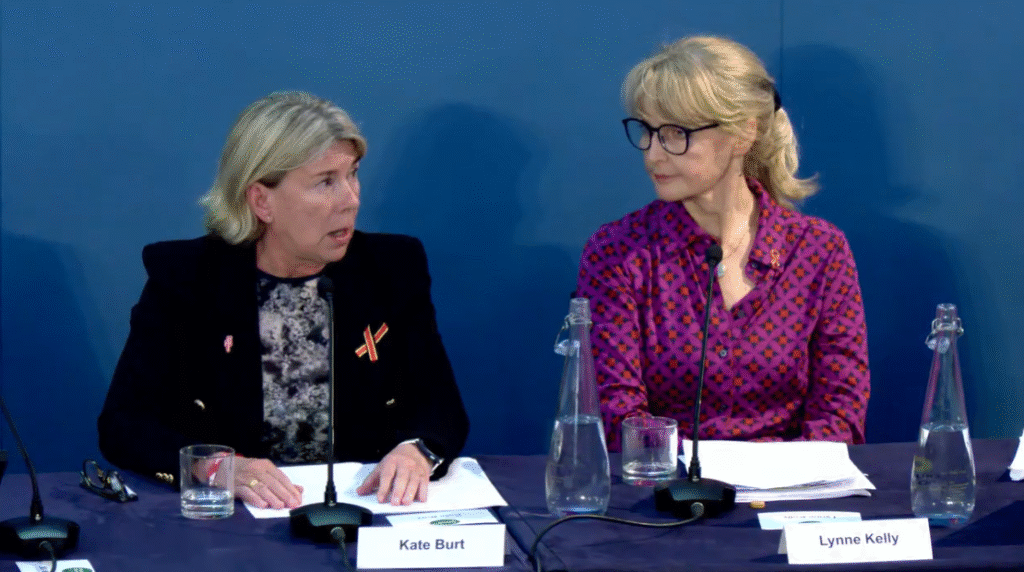
Kate Burt, Chief Executive of the Haemophilia Society, told the inquiry that there had been ‘political manipulation’ of the whole community and that the government had failed to listen to the people at the heart of this scandal. She said the ‘deep injustice’ that was felt by many had to be addressed.
Each panel member made strong, moving points. Andy Evans, founder of Tainted Blood, quoted a member of the group about their experience of the last 12 months. They said: ‘This past year has not simply caused more psychological damage; it has brought a new and different layer of psychological pain, another layer I’ve had to endure, adapt to and fight every day to not let it take over my life.
‘What has happened since the compensation scheme was announced has pushed that fight to its absolute limit and now I am utterly exhausted. I can’t keep going like this. I am on the brink of a mental health emergency. That’s not exaggeration. The anguish is beyond words. I just want this over.’
Alan Burgess, from the Birchgrove Group, said waiting to hear if your compensation claim was going to be processed was like ‘waiting for your lottery ticket to come up’ and was causing huge anxiety and distress.
There were some common themes across all the evidence from the panel of campaigners. They highlighted the need for government to listen, to act transparently, and to address some of the flaws of the compensations scheme. These included:
- Looking again at the tariffs for mono-infected hepatitis C to ensure they reflected the damage caused, particularly in reference to the impact of interferon, an early, harsh treatment.
- Looking again at financial loss tariffs which stop at the point of death, meaning the estates of those who died young would receive significantly less.
- Speeding up the number of compensation claims being processed.
- Allowing a compensation claim for the estates of the affected. As the scheme stands, any individual claim from and affected family member (sibling, parent, child, carer) dies with them.
- Reversing the decision to stop the partners of people on a UK support scheme receiving on-going support payments on their partner’s death.
- Allowing more support in the compensation process from recognised legal representatives.
After the panel, Mr Thomas-Symonds was called to give evidence. He began by apologising to the infected blood community for the failure of the state over many decades. He was appointed Paymaster General on 7 July 2024, immediately following the general election. The minister said the need to ‘push forward as quickly as possible’ meant there was no formal consultation about the proposed compensation scheme, which was published in draft form in August 2024.
The inquiry was told that the previous government had appointed an expert group to advise it on forming a compensation scheme whose identity was kept secret, apart from its chair, Sir Jonathan Montgomery, until its report was published. It emerged at that point that the expert group did not contain people with specialisms in treating bleeding disorders, treating psychosocial conditions or managing transfusions, all key areas of expertise in considering the needs and experiences of the infected blood community.
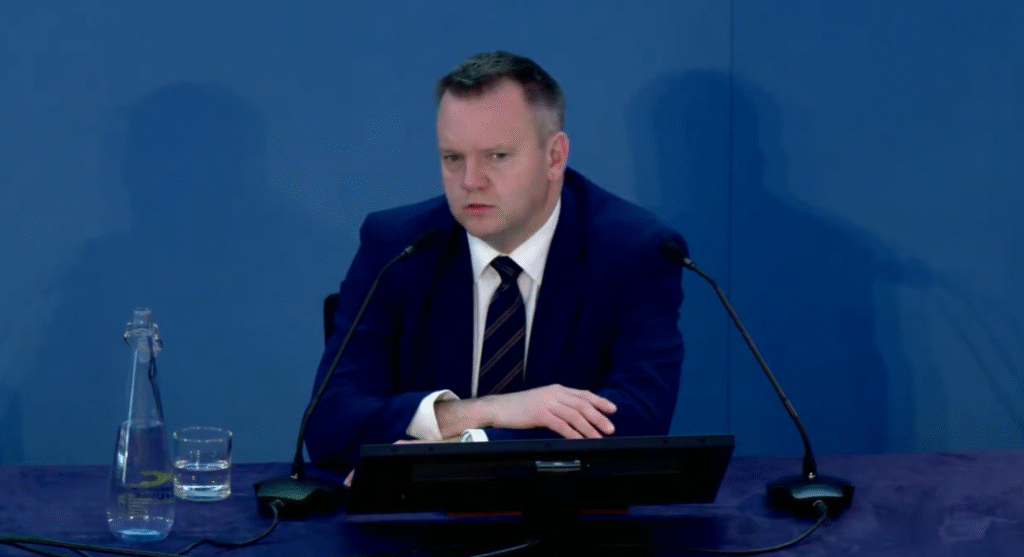
The inquiry’s Lead Counsel, Jenni Richards KC, put to Mr Thomas-Symonds, pictured left, that the body which has been set up to administer compensation is the ‘opposite of completely independent of government’ which is what the inquiry had recommended. The compensation body, called the Infected Blood Compensation Authority (IBCA) has no powers to set compensation tariffs, determine eligibility or set any rules. Its role is to deliver payments, following the government’s regulations.
Mr Thomas-Symonds said that although the compensation scheme he inherited was not what the inquiry recommended, he decided to keep it to avoid further delays. He said some changes had been made, such as widening eligibility for siblings and maintaining support scheme payments for life.
He said it was ‘profoundly unsatisfactory’ that only 106 people have so far received compensation. Asked about IBCA’s estimation that the ‘bulk’ of affected payments would be made by 2029, he said this was ‘far too long’ and that this date represented a ‘backstop’ which he hoped would not be reached.
He was also asked about the Special Category Mechanism, which is a system used by the UK support schemes to trigger a higher payment in recognition of the impact on quality of life of infection with hepatitis C. In the government’s original plans, the same system was going to be used in the compensation scheme’s ‘supplementary route’ – which sets out additional circumstances which allow people to claim extra compensation. These include serious health conditions which result from the infections as well as severe psychological impact. The reality of the ‘supplementary route’, the inquiry was told, is that most people would not be able to claim for psychological impact because the burden of proof was so unrealistically high that it would exclude most applicants.
After listening to the evidence, Mr Thomas-Symonds agreed to consider the following issues:
- Revisiting the proof needed to evidence psychological damage.
- Revisiting a ruling that HIV infections prior to 1 January 1982 fall outside the government’s ‘liability window’.
- Giving IBCA the power to make decisions on unethical research payments – not the amount but the centres where this occurred.
- Whether the Special Category Mechanism described above should be included in the ‘supplementary route’ payments.
- Creating an additional way (another ‘supplementary route’) for the affected (children, parents, siblings and carers) to receive extra compensation payments to recognise personal impact and loss.
- Reinstating on-going bereaved partner support.
- Talking to IBCA about speeding up claims.
Sir Brian told Mr Thomas-Symonds that in agreeing to review the list above he ‘held the trust of the community in your hands’. He said the minister’s future decisions on the compensation scheme would either ‘rebuild’ or ‘jettison’ that trust.
On 8 May the inquiry heard evidence from David Foley, interim Chief Executive of IBCA and its interim Chair, Sir Robert Francis. Later, there was evidence from James Quinault, a senior Cabinet Office civil servant who is director general of its public inquiry response.
Mr Foley and Sir Robert described IBCA’s ‘test and learn’ process which was an attempt, they said, to ‘build something that works’. The inquiry was told that IBCA currently has 100 claims managers, rising by 40 a fortnight until it gets to a total of 500. On average, 10 claims are assigned to each claim manager at any given time. It takes an average of 39 days from the first day a person is approached about a claim to payment. The quickest claim took five days.
Mr Foley said IBCA was aiming to approach all 3,500 infected people registered on a UK support scheme by the end of this calendar year to start their claims.
Both agreed that the pace of compensation roll out was too slow, but Mr Foley felt that from a ‘standing start’ in May 2024 when IBCA consisted of two people, the payment of compensation to 106 people so far was a ‘substantial achievement’.
Finally, in his evidence, Mr Quinault said that Cabinet Office civil servants, assisted by some from the Department of Health would have proposed potential specialists to join the government’s expert group which advised on the compensation scheme. He said minutes from those meetings would be given to the inquiry.
He acknowledged that the current compensation scheme had not won the ‘trust and confidence’ of the community. Mr Quinault said the Cabinet Office would have to look again at the points people are making about the scheme and the areas where they don’t feel heard.
Sir Brian will now write a report based on the oral evidence taken at the hearings and written submissions. The deadline for handing in written submission is 23 May 2025. He said the report would be written as quickly as possible but explained that there were some procedures which had to be followed that could delay the process somewhat.
You can watch the evidence on the Infected Blood Inquiry’s YouTube channel or read the transcripts here. Contact us at [email protected].